
Compare the policy you would actually use
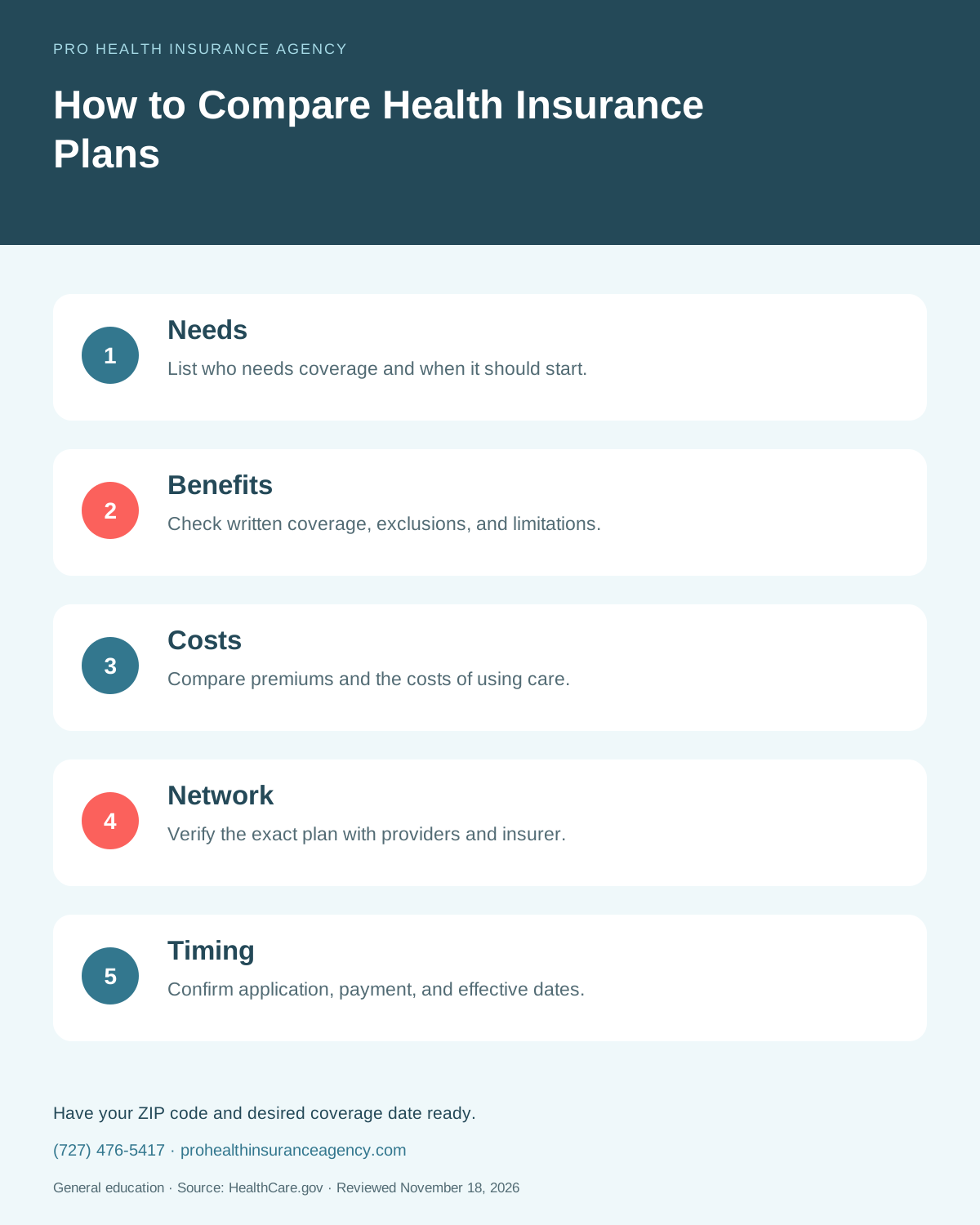
Compare health insurance plans by checking total costs, provider access, covered benefits, and the date coverage can begin. Start with your needs, then use the same checklist for each candidate policy. A lower monthly premium or a familiar insurer's name does not, by itself, tell you which plan will fit. For St. Petersburg residents, a useful comparison also begins with the residential ZIP code where coverage is needed. Pro Health Insurance Agency can discuss your questions at (727) 476-5417.
Write a short decision brief
Before opening several plan brochures, write down why you are shopping. Perhaps other insurance is ending, a renewal payment has increased, or your family needs a different provider arrangement. Record the date you would like new coverage to begin. Then list the people who need insurance and the providers or medicines that matter to them. This short brief keeps the comparison tied to an actual decision. Without it, an attractive feature can distract you from a requirement that matters much more. Keep personal details in a private document rather than posting them in a general website message.
Confirm what kind of product is being discussed
Ask for the exact policy name, product type, coverage year, and written benefit materials. Two products described as health coverage may have different benefits, exclusions, limitations, or renewal terms. A monthly price is not enough to establish equivalence. If one option appears substantially cheaper, identify which policy provisions explain the difference. Read any limits on the services you expect to use. For Marketplace plans, HealthCare.gov explains that metal categories describe cost sharing, rather than the quality of care. Keep product type, plan category, and provider network separate in your notes so one label is not mistaken for another.
Compare payments across a year
Put the recurring premium beside the costs you may face when receiving care. A deductible can affect when certain benefits begin, while copayments and coinsurance can affect particular services. Read the applicable out-of-pocket limit and the expenses it excludes. For a full year, multiplying a monthly premium by twelve gives one part of the comparison, but it is not the whole annual cost. Review a quiet year and a year with more appointments. These scenarios are planning tools, not predictions or quotes. They help reveal which expenses you would need to manage from savings if care needs increased.
Check providers using the exact network
List each doctor, hospital, specialist, and pharmacy you want to keep. Use the insurer's current directory for the particular product and coverage year. Then confirm participation with the practice at the location you actually use. A statement that a practice accepts an insurer can be too broad when that insurer has several networks. Ask what happens if a specialist referral or prior authorization is required. If directory information conflicts with the provider's answer, resolve the conflict before enrolling. Keep a record of the plan identifier and the confirmation date so a later conversation can refer to the same information.
Check prescriptions beyond the medicine's name
For each medicine, identify its name, strength, and usual pharmacy in your private checklist. Check the plan's formulary and ask how the relevant tier, deductible, copayment, or coinsurance applies. A covered medicine may still involve conditions such as authorization, quantity limits, or an initial requirement to try another drug. Confirm those details with the insurer. Do not assume that a medicine's treatment under your current policy will carry over to a different product. If a question remains unresolved, leave it clearly marked in your notes rather than converting an assumption into a confirmed benefit.
Read the rules around using care
Look beyond a list of benefits to the process for accessing them. Does the plan use a network that fits your routine? Are referrals needed for the kind of specialist care you expect? How are laboratory work, imaging, or outpatient facilities treated? Ask the insurer to distinguish covered care from excluded care and to explain any applicable approval requirements. These questions help you compare the experience of using the policy, not simply the act of buying it. They are especially useful when two options appear similar in their headline deductible or monthly premium.
Confirm enrollment and effective dates
Identify the application window that applies to your circumstances. For Marketplace coverage, a Special Enrollment Period depends on qualifying conditions, and rules can differ by event. Have the date of any coverage loss or other relevant event ready. Ask what documentation is required, when a selection must be completed, and when coverage could start. Confirm the first-payment process and how to check that the policy is active. Do not treat an inquiry, saved quote, or application acknowledgement as proof of insurance. Coordinate the end of any current policy only after understanding the proposed replacement's effective date.
Use one comparison sheet
Create a column for each plan and use identical rows: exact name, network, premium, deductible, common visit charges, prescriptions, out-of-pocket limit, exclusions, and effective date. Add a final row for unresolved questions. This format prevents a detailed answer about one policy from being compared with an assumption about another. Note where each answer came from, such as the benefit summary, insurer directory, or direct confirmation. If you revisit the decision later, those sources are more useful than a collection of screenshots whose plan names or dates are missing.
Compare the questions that remain unanswered
Imagine that one policy has a confirmed provider match while another has only a general directory result. Those are different levels of certainty, even if the second option has a smaller premium. Give each unresolved item an owner and a next action: ask the insurer about a benefit, ask the practice about the network, or locate the relevant policy document. If a deadline is approaching, prioritize questions that could rule an option out. This method keeps a comparison honest and reduces the chance of choosing from incomplete information simply because one brochure looks easier to read.
Turn the comparison into a next step
Choose the questions that would change your decision and resolve those first. A provider mismatch, an unaffordable care expense, or an unsuitable start date may matter more than a small premium difference. Ask for the written materials needed to verify the final choice. If you are comparing coverage for one person, see our individual insurance page. For several household members, start with family coverage. Pro Health Insurance Agency's St. Petersburg contact can help you organize the discussion; the actual policy and application rules determine the coverage available to you.