
Start with each person's needs
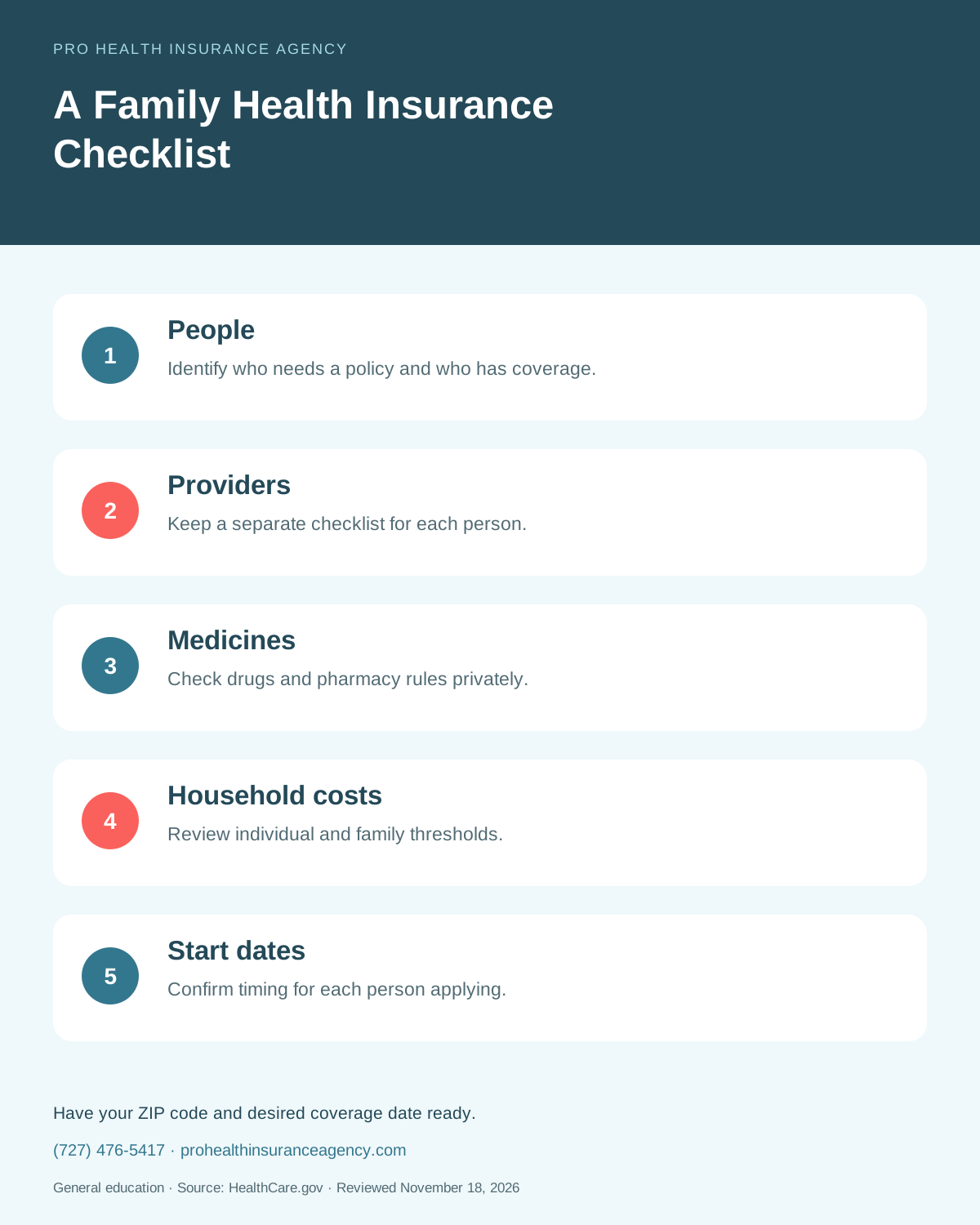
A useful family health insurance checklist identifies who needs coverage, preferred providers, prescription needs, expected care, household cost sharing, and the desired start date. Compare those details for every candidate plan before focusing on its monthly premium. A family policy is easier to assess when the household's priorities are written down separately for each person. Pro Health Insurance Agency helps St. Petersburg families discuss health insurance options at (727) 476-5417. This checklist provides a practical way to prepare for that conversation without assuming that one benefit suits everyone.
Define who actually needs a policy
List household members who need coverage and note any insurance that may continue through work or another arrangement. Do not begin by assuming everyone must choose the same option. The available choices and application rules should be checked for the people involved. Record the dates existing coverage would end or renew. If family members have different transition dates, keep them separate. This establishes the scope of the comparison and prevents a discussion about one person's new policy from accidentally becoming an assumption about the entire household's coverage.
Make a provider list for each person
Identify the doctors, specialists, hospitals, and pharmacies each person wants to use. Include the actual practice location and distinguish essential preferences from arrangements that could change. A child's regular practice and an adult's specialist may participate in different networks. Verify them using the exact product, network, and coverage year being considered. Then confirm participation with the practice. A statement that an office accepts a familiar insurance company may not establish participation in the particular plan. Mark every unresolved provider question before comparing the policies as if access were equivalent.
Keep prescriptions in a private checklist
Record medicine names and strengths privately, then check the formulary and pharmacy rules for each policy. Ask about tiers, prescription deductibles, copayments, coinsurance, authorization, quantity limits, and any other applicable conditions. One person's medication could materially affect a household's cost comparison even when the family rarely uses other care. Keep details out of a general website message and arrange an appropriate direct conversation. A medicine's presence on a list is only part of the answer; how it is covered and where it is filled can matter too.
Compare individual and household deductibles
Ask how expenses for one person interact with the family deductible. Read whether an individual threshold can apply before the overall household amount is reached, and which benefits operate under each condition. Do not infer the structure from the size of the number alone. Use a simple example involving one member's care, then another involving expenses across several members. The purpose is to understand the rule, not predict a future bill. Keep the written benefit explanation available so everyone discussing the policy is referring to the same provision.
Review the limits as carefully as the payments
Compare the monthly premium alongside the applicable individual and family out-of-pocket limits. Ask which expenses count and which do not. Premiums, noncovered care, and out-of-network expenses can be treated differently from qualifying covered cost sharing. A limit is useful only when you understand its boundaries. Consider what the family could reasonably set aside for care expenses and what would cause financial strain. Our cost terminology guide explains why a low recurring payment does not, by itself, establish the most workable overall budget.
Discuss different care patterns
One household member may use regular specialist appointments while another mainly needs occasional routine visits. Build a comparison around those different patterns. Ask about primary care, specialists, urgent care, laboratory services, and any other benefits likely to matter. Check referral and authorization rules rather than focusing only on a stated visit copayment. If the family travels or spends time in more than one location, ask how routine care works away from the usual service area. The comparison should reflect everyday life, while allowing for uncertainty about future needs.
Check whether a life change affects timing
A birth, marriage, move, or loss of other coverage may lead to enrollment questions, but the applicable rules depend on the event and circumstances. HealthCare.gov's Special Enrollment Period guidance distinguishes qualifying situations and their conditions. Keep the exact event date and any coverage end dates ready. Ask which people can apply, what documentation is needed, and when coverage could begin. Do not assume every household member has the same deadline. Review current official guidance when the decision is being made because application rules and dates can change.
Separate your comparison from enrollment
After comparing plans, confirm the remaining application and payment steps. Ask how the agency or insurer will communicate the effective date and how to check that the policy is active. Coordinate any existing coverage carefully; a request for information is not a replacement policy. Keep notices and plan documents together so one adult can follow up if another started the process. If an answer is still pending, write it down. A checklist is most useful when it makes unfinished work visible instead of giving the impression that every step is already complete.
Agree on which tradeoffs the household can accept
Discuss priorities before choosing between final options. Keeping one specialist, limiting the monthly commitment, and maintaining a familiar pharmacy may each matter differently to different people. Separate requirements from preferences and identify which questions need more information. If the household would consider changing a provider, check appointment availability with the alternative practice before assuming the transition will be simple. If a potentially large care expense is the concern, discuss how the family would budget for it. A shared understanding of these tradeoffs makes the comparison more practical than choosing the smallest premium and discovering disagreements after enrollment.
Bring the checklist to a local conversation
Have your residential ZIP code, household coverage list, desired start dates, and current policy summaries ready when contacting Pro Health Insurance Agency. The public business location is St. Petersburg, FL 33716; arrange any in-person meeting directly before traveling. Explore our family coverage page for the service overview, or the plan comparison guide for a broader worksheet. The goal is to leave the discussion knowing which options were considered, how their terms differ, and which questions still need written confirmation before your household makes an insurance decision.