
Four terms that answer different cost questions
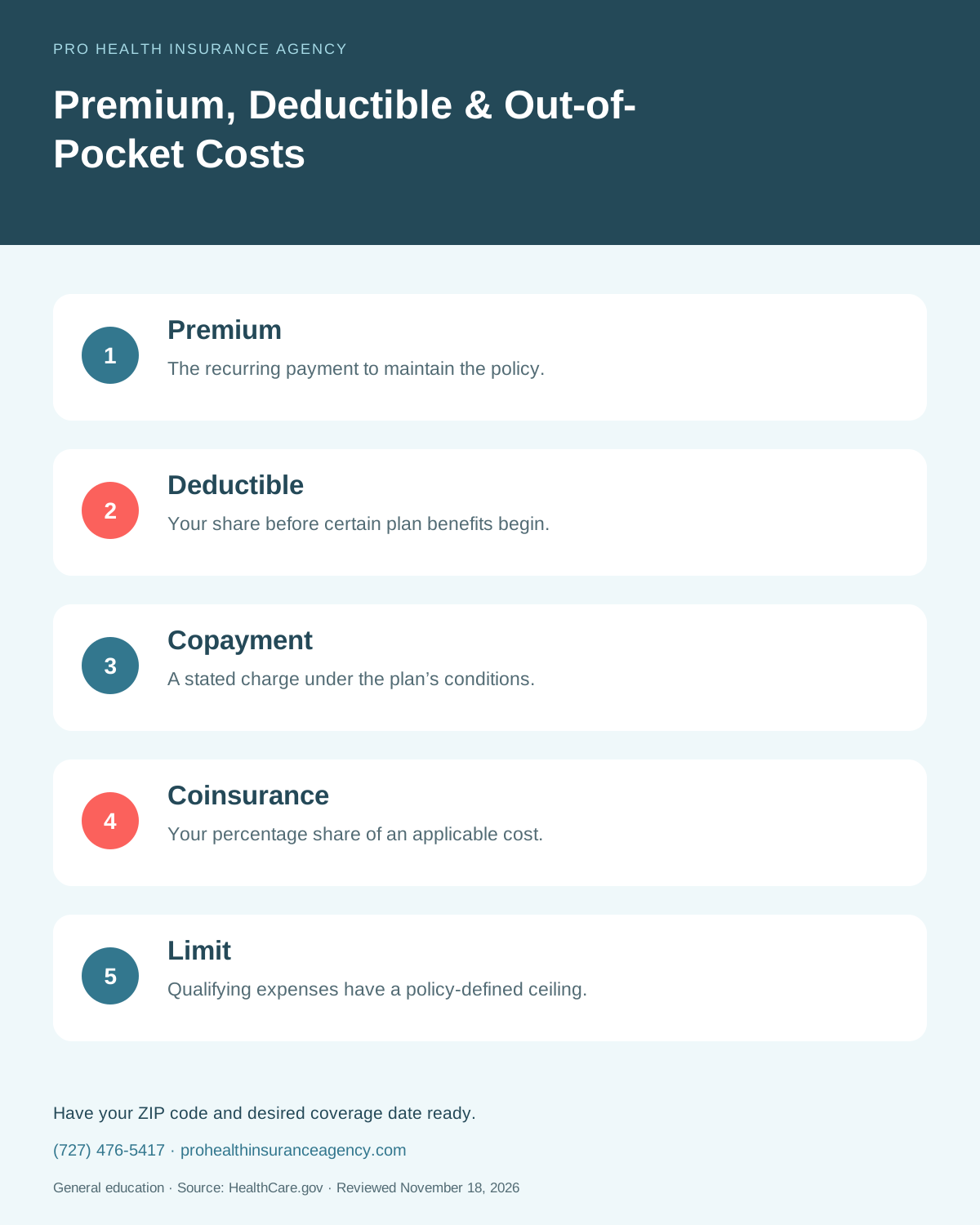
A premium is the recurring payment for a policy; a deductible describes certain costs you pay before specified benefits begin; copayments or coinsurance describe your share when using care; and an out-of-pocket maximum limits qualifying expenses under the plan's rules. Compare all four before choosing health insurance. None of them, alone, describes your complete budget. Pro Health Insurance Agency helps St. Petersburg individuals and families discuss plan costs at (727) 476-5417. Use the guide below to prepare specific questions about the policy you are considering.
The premium keeps coverage in place
The premium is the payment due to the insurer to maintain the policy, subject to its terms. You generally pay it even in a month when you do not visit a doctor. For a full twelve-month comparison, the monthly premium multiplied by twelve shows the recurring annual payment before care expenses. If coverage would begin partway through a year, use the actual period being compared. Ask when the first payment is due, how payment should be made, and how you will confirm activation. A quoted premium and an active policy are different stages of the process.
The deductible affects specified benefits
A deductible is the amount you may have to pay for certain covered services before the plan begins paying under the relevant rules. Do not assume that every service works the same way before the deductible. A policy may treat some benefits differently, and prescription coverage may have its own provisions. Read the benefit summary service by service. Ask what happens when you book a routine office visit, obtain laboratory work, or fill a prescription. Concrete examples are easier to assess than a broad assurance that the deductible is low or high.
A copayment is a stated charge
A copayment is typically a fixed amount for a covered service under the policy's conditions. The fact that an office visit has a copayment does not necessarily mean every related expense is included. A separately billed test or service may follow a different benefit rule. Ask how the plan treats the visit itself, any associated facility charge, and other services likely to occur. Confirm whether the copayment applies before or after the deductible. Keep the answer tied to the exact plan, because a familiar benefit structure from a previous policy may not apply.
Coinsurance is a share of an applicable amount
Coinsurance describes a percentage share of the relevant covered cost under the policy. To understand what it could mean, ask which allowed amount the percentage applies to and whether the deductible must first be met. A percentage written on a brochure is difficult to budget without context. Request a general explanation using the type of service you expect, while recognizing that an example is not a guaranteed bill. Network status, the specific service, and other policy conditions can change the amount you owe. Keep those assumptions visible when comparing examples.
The out-of-pocket maximum has boundaries
The out-of-pocket maximum applies to qualifying covered expenses under the plan's rules. It does not mean that every health-related payment counts toward the limit. Premiums, noncovered services, and out-of-network expenses can be treated differently. Read the exclusions rather than adding every receipt to one imagined total. Ask which deductible payments, copayments, and coinsurance contribute to the limit and how the insurer tracks them. For a family, confirm whether individual and household limits operate separately. The written explanation matters as much as the number shown at the top of a summary.
Look at an ordinary year and a busier year
Begin with a plausible routine: the kinds of appointments, prescriptions, and services you already know about. Then consider a year with more care and ask how the policy would share qualifying costs. Avoid trying to predict an exact future bill. The purpose is to understand the structure and identify expenses that could strain your budget. A plan with a smaller recurring payment may expose you to different costs when care is used. Another may require a higher monthly commitment while treating particular services differently. Compare the tradeoff using the same assumptions for both.
Family policies need an additional question
When several people are covered, ask how a single person's expenses interact with family deductibles and limits. Does a person's qualifying spending reach an individual threshold before the family total is met? Which benefits start under each condition? Read the policy's explanation rather than inferring the answer from the word family. Keep separate notes for an adult's ongoing care and another member's occasional appointments. Our family checklist helps organize the people and providers involved so cost sharing can be discussed against real household priorities.
Network and coverage rules affect the calculation
A mathematically attractive combination of premium and deductible can still be unsuitable if the plan does not cover a needed service or provider arrangement. Verify the exact network, covered benefits, prescription rules, and any approval requirements. Ask whether a quoted example assumes in-network care and whether the service is covered at all. Do not use an out-of-pocket maximum to make an excluded expense disappear from your budget. Our provider guide explains how to check doctors and medicines before relying on a cost comparison.
Keep estimates distinct from confirmed charges
A cost example usually depends on assumptions about the service, network, allowed amount, and benefit rules. Write those assumptions beside the result. If one changes, the estimate may change too. Ask whether a figure describes only the clinician's service or includes separately billed work. For planned care, the insurer and provider can explain which details are needed for a more useful estimate. This does not make future charges perfectly predictable, but it prevents a simple percentage or sample visit payment from being mistaken for a complete financial commitment covering every related expense.
Make a usable cost worksheet
Write each plan's exact name and year above five rows: premium, deductible, common copayments, coinsurance, and out-of-pocket maximum. Add notes for exclusions, network assumptions, and unanswered questions. Keep the written policy summary nearby as you discuss the figures. HealthCare.gov recommends comparing estimated total yearly costs rather than premiums alone. If cost is your main concern, review our affordable coverage page and call the agency with your current summary or renewal notice. A clear worksheet turns insurance vocabulary into practical questions without pretending to predict every future medical expense.