Start with the date existing coverage ends
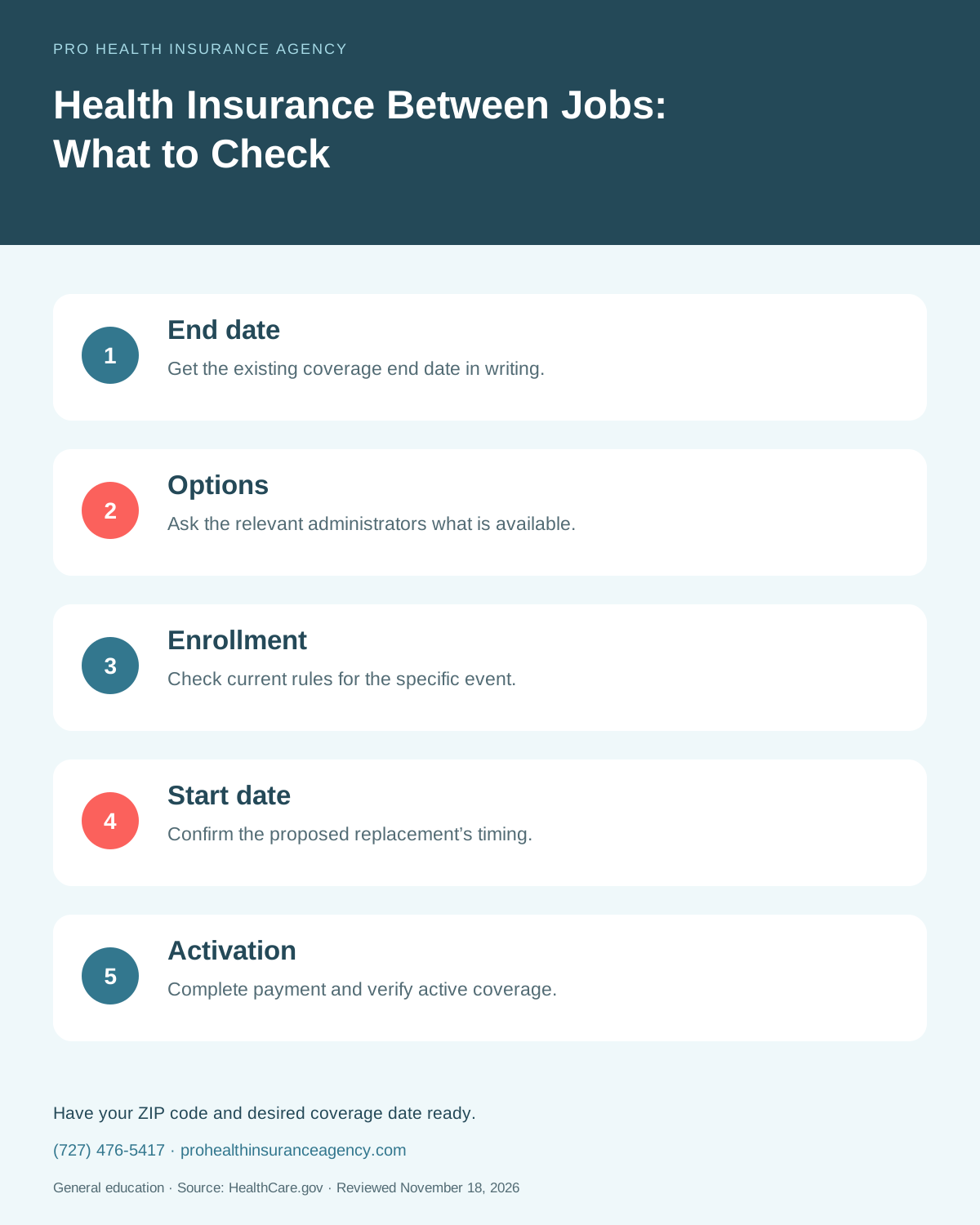
When health insurance may change between jobs, first obtain the exact end date of existing coverage, then check available replacement options, enrollment windows, effective dates, and payment requirements. A job change and a coverage loss are related facts, but they are not interchangeable. Do not cancel a policy or assume a new one is active simply because an inquiry has been submitted. Pro Health Insurance Agency helps St. Petersburg residents discuss individual and family health insurance questions at (727) 476-5417. Use the steps below to organize a time-sensitive conversation.
Get the current coverage timeline in writing
Ask the employer or plan administrator when your current coverage actually ends. Your last working day may differ from your last insured day. Obtain the written notice and identify which household members are affected. Keep the policy name and administrator's contact information with that notice. If an answer is unclear, resolve it before using the date to plan a replacement. A precise timeline is more useful than a general statement that coverage ends soon. It also gives anyone helping you the information needed to discuss possible application windows and start dates.
Identify every option worth checking
Depending on your circumstances, questions may include a new employer plan, a household member's job-based plan, continuation coverage, or individual insurance. Availability and rules should be confirmed with the relevant administrator or insurer. Do not treat a general list as a determination of your eligibility. Write the potential options down and identify who can answer each one. For example, the next employer can explain its waiting period, while an existing plan administrator can explain continuation information. Keeping responsibilities clear prevents one conversation from being mistaken for confirmation of all available choices.
Check Marketplace enrollment rules for the event
HealthCare.gov explains that qualifying loss of health coverage can create a Special Enrollment Period, subject to applicable conditions and timing. Review the rules for the actual event rather than assuming every change in employment qualifies in the same way. Have the coverage end date and any required documentation ready. Ask when a plan must be selected and when coverage could begin. An official eligibility process determines the result; a short website inquiry does not. Use the current guidance when making the decision, especially if the event or timing is unusual.
Compare effective dates before prices
A low premium does not solve a transition if the proposed start date leaves an unplanned gap. Put the end date of existing insurance and the earliest confirmed start date of each replacement option on the same timeline. Ask which application, verification, and payment steps affect activation. If a start date is conditional, label it that way in your notes. Do not schedule cancellation based on an estimate that has not been confirmed. Once the timeline makes sense, compare costs and benefits using the exact policies available for those dates.
Review providers and prescriptions again
A new policy may use a different network even when the insurer's name looks familiar. Verify doctors, facilities, pharmacies, and medicines using the exact plan and coverage year. If you have planned care or regular prescriptions, ask how the transition could affect access and any approval requirements. Keep medical details in an appropriate private conversation. Our provider and prescription guide explains the checks to make before relying on a directory entry. A transition is a useful moment to refresh those checks rather than assuming previous arrangements automatically continue.
Budget for the transition period
Compare the recurring premium with deductibles and other care expenses under each option. Ask whether changing plans affects deductible accumulation and what the new policy's rules say. Avoid assuming amounts already paid under one policy transfer to another. For a family, ask how individual and household limits apply. A transition can also change income information relevant to an application, so keep estimates current and ask how later changes should be reported. Our cost guide helps organize the vocabulary without turning a general example into a personalized quote.
Check each household member separately
A spouse or child may have a different coverage source or a different opportunity to join another plan. List who is losing insurance, who could keep existing coverage, and who needs a new start date. Check the requirements for the people actually applying. Do not assume that one person's new employer arrangement automatically answers the entire family's needs. Keep provider and prescription priorities for each person beside the timeline. Our family checklist provides a practical way to combine those details without overlooking someone whose circumstances differ from the rest of the household.
Complete the remaining steps deliberately
After selecting a possible route, confirm who submits the application, where any first payment goes, and how activation will be verified. Retain confirmation notices and policy materials. Ask what to do if additional information is requested or a deadline approaches before an answer arrives. A saved quote, request form, or application acknowledgement should not be treated as proof of active insurance. If there is a discrepancy between expected and confirmed dates, contact the responsible insurer or administrator promptly. Keep the existing policy's cancellation rules separate from the replacement's enrollment requirements.
Keep a small transition file
Save your coverage-ending notice, benefit summaries, application confirmations, payment instructions, and important contact details in one place. Record dates of conversations and the next action each person agreed to take. A concise timeline helps distinguish something you requested from something an insurer or administrator has actually confirmed. If another household member needs to follow up, the file should identify the exact policy and open question without requiring them to reconstruct the entire discussion. Keep the documents private and use the provider's approved method when sending anything that contains personal application information.
Make the first call concrete
Contact Pro Health Insurance Agency with your residential ZIP code, written coverage end date, the number of people affected, and the decision you need help understanding. Say clearly if a deadline is close, and use the phone for a time-sensitive question. Explore individual coverage or family coverage before the conversation if useful. The agency's public business location is St. Petersburg, FL 33716. A clear timeline and a short list of priorities help turn an uncertain job transition into a set of specific questions whose answers can be checked against official guidance and actual policy documents.